I’ve always thought it odd that you can’t tip an uber driver in-app, sure you can give them cash — but who carries that around anymore? I get that they want a friction free experience, but maybe there’s a way to have both.
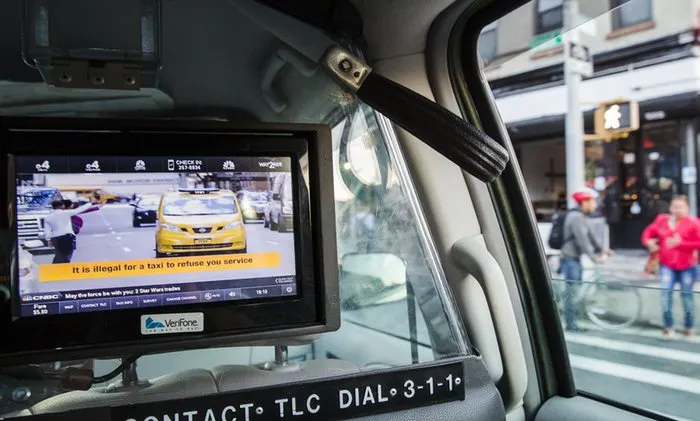
Use the money from you watching Ads on the journey to:
1. Tip driver
2. A journey in a country where uber is cheaper — for charity or when you’re travelling.
3. Get closer to free
1.Tipping the drive
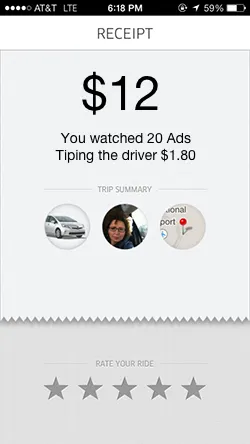
Do the numbers work?
Working backwards — an average 10 minute trip price = $12
A tip of 15% would need to be = $1.80
Ad sales team & tech costs of ~20% (assumes no profit)= $0.40
Max number 30 second Ad slots = 20
Min CPV (Cost per Ad viewed)=$0.11
Equivalent CPM = $110
Driver earns = $0.09 per Ad you watch
(assumes a 100% ad fill rate, and no profit taken by Uber — both unlikely.)
2. Free ride?
Theoretically if you were a US citizen travelling abroad to a city where uber is cheap, but shown Ads relevant to you from US advertisers, your ride could net out free –
Cheapest 5km 10 minute Uber cities:
- $1.17 — Jakarta, Indonesia
- $1.33 — New Delhi, India
- $1.47 — Cairo, Egypt
- $1.51 — Hanoi, Vietnam
- $1.58 — Beijing, China
- $1.61 — Kuta, Bali, Indonesia (Uber Black)
- $1.64 — Bangkok, Thailand
- $1.91 — Kuala Lumpur, Malaysia
- $1.93 — Manila, Philippines
- $2.04 — Mumbai, India
Why is it attractive for Advertisers?
- Affluent users
- All users have a phone with uber app installed
- Captive attention
- Uber is a hot brand to associate with
- Know where the user is going so can be localised to destination / venue.
- Targeting data based on the user’s phone
- Have brand engagement on 2nd screen inside uber app
- List brands seen & link in uber receipt email
Respecting the user
From a users perspective this is about exchanging their attention for a frictionless way to give a tip to their driver.
- User must be able to turn off at any time
- Should start with the audio off — muted
- Any targeting data must be anonymised
- User must be able to choose how much of the tip driver receives
Hasn’t it been done before?
…In a very basic way in NYC taxi cabs, and people hate it. It’s never really been successful as it’s really an old school Ad Network play & doesn’t have much data:
– doesn’t the destination as you tell the driver not the device
– limited real time connectivity & decisioning
– there’s no matching app so advertisers can’t use phone targeting data
– they’re obnoxious, users hate them — mute rarely work & content static
– a very 90’s experience, people use their phones for city map & info
– no value exchange for the user
So I built a prototype!
I decided to build one to see how much better the experience could be made, concentrating on the user experience and connecting app to screen.
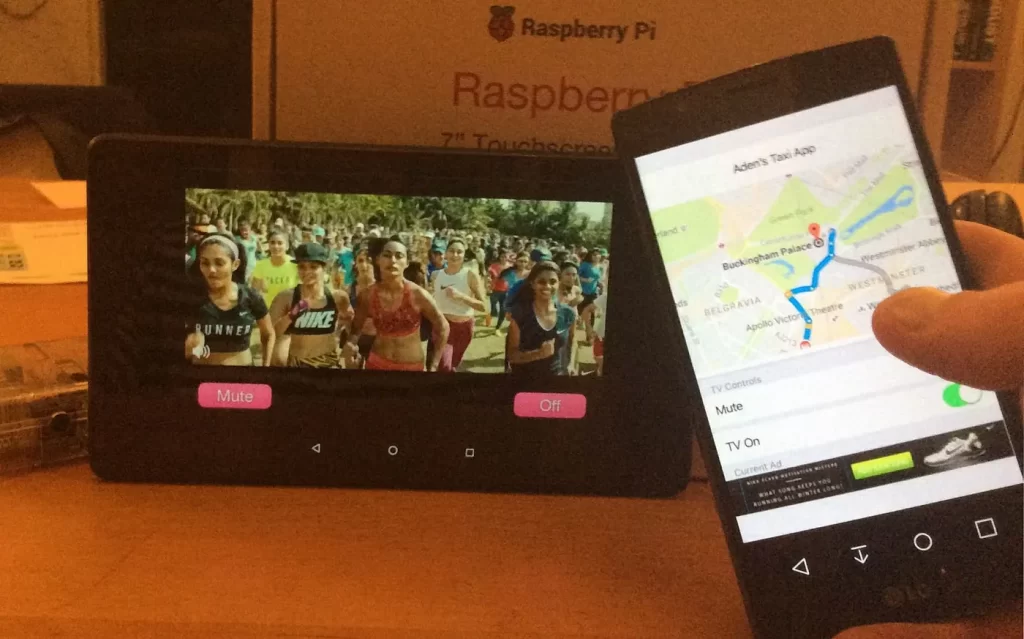
Cab TV touchscreen app:
- High speed 4G connection
- Live hookup to a full video adtech stack
- Syncs user data from app
- Syncs user preferences from app (screen off by default)
Paired with a Uber style mobile app:
- layered with CPA links to sponsored destinations like starbucks or local restaurants.
- A banner connected to the current playing Ad for direct response clickthrough
- CPL links for downloading apps
- User can share the TV’s data connection (free wifi)
- Control volume & engage with brand via phone app
3. Getting closer to free
As cars become driverless, electric powered, and shared — the cost of moving from point A to B will be commoditized. Then, just as Google has done for search, and Facebook has done for communication, an Ad supported model might work.
That… is some years off.
Conclusion
For now it’s only feasible for short journeys as there would be too many Ads for a long one. Uber would need to command consistently Ad high rates to make the numbers work, and attract enough Advertisers to guarantee high fill.
There’s value to be added, but below 15% of the total fare isn’t enough for now.
The concept has legs if iterated away from a pre-roll model to a unique compelling Ad format, after all lots of transit systems like the london underground advertising is a key part of keeping costs down for their customers. As a company that’s still in high growth phase and on a land grab for customers, potentially alienating those users is a risky proposition.
In a few years when all the old taxi companies & competitors have been swallowed up by the Uber & its chinese partner then maybe so, by then it’ll be all driverless cars — so who i will be left to tip?